
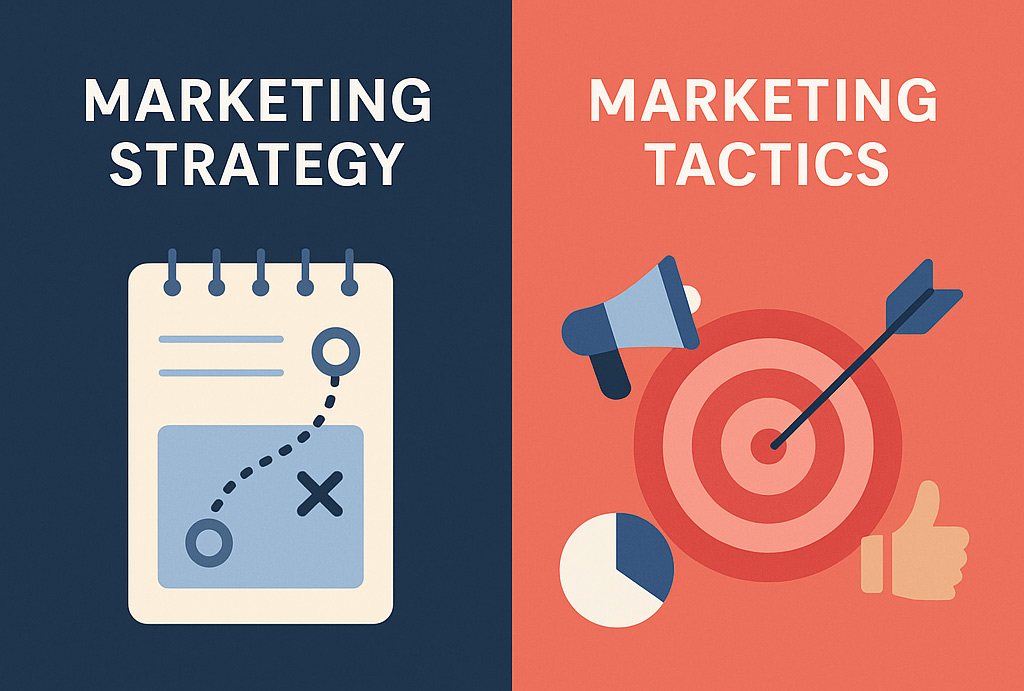
In modern marketing, “strategy” and “tactics” are two of the most overused—and misunderstood—terms. Many professionals treat them as synonyms, but they serve very different purposes.
Understanding the difference between marketing strategy and marketing tactics is essential for building a brand that lasts. This post breaks down each concept, explains why people often mix them up, and shows how strategy and tactics work together to create powerful marketing results.
What Is a Marketing Strategy?
A marketing strategy is your long-term roadmap — the master plan that defines what your brand wants to achieve, who it’s for, and how it will win in the market. It’s the “big picture” that guides every marketing decision and ensures all efforts align with business goals.
Core Elements of a Marketing Strategy
- Business Objectives: What does the company want to accomplish overall?
- Market Research: What’s happening in your market, and what gaps exist?
- Target Audience: Who are you serving, and what do they care about?
- Positioning: How will your brand be perceived and differentiated?
- Messaging: What value promise resonates most with your audience?
- KPIs (Key Performance Indicators): What long-term metrics define success—brand awareness, revenue growth, or customer retention?
A marketing strategy is about direction, not execution. It answers the questions:
“What do we want to achieve?” and “Why is it important?”
Example: Marketing Strategy in Action
Let’s say a sustainable skincare brand wants to dominate the eco-beauty market.
Its strategy could look like this:
- Goal: Become the leading sustainable skincare brand in North America within two years.
- Target Audience: Women aged 25–40 who value ethical beauty and transparency.
- Positioning: “The clean beauty brand that’s as kind to your skin as it is to the planet.”
- Core Approach: Build brand trust through sustainability storytelling and ethical sourcing transparency.
That’s strategy — a clear vision that guides every tactical move.
What Are Marketing Tactics?
If strategy is the plan, marketing tactics are the actions.
Tactics bring your strategy to life through specific campaigns, channels, and tools. They’re shorter-term, measurable, and flexible.
Key Characteristics of Marketing Tactics
- Short-term and execution-focused
- Actionable and easily adjustable
- Aligned with strategy
- Measured by performance metrics like clicks, conversions, or engagement
Example: Marketing Tactics
For the same skincare brand:
- Publishing blog posts about eco-friendly skincare routines
- Launching Instagram Reels that highlight sustainable packaging
- Partnering with green influencers for product reviews
- Running Google Ads targeting “organic skincare products”
These are tactical executions that bring the brand’s sustainability story — the strategic foundation — to life.
Marketing Strategy vs. Marketing Tactics: The Core Difference
Here’s how to distinguish the two clearly:
| Aspect | Marketing Strategy | Marketing Tactics |
|---|---|---|
| Definition | Long-term vision and plan | Short-term actions and methods |
| Focus | “What” and “Why” | “How” |
| Purpose | Provide direction | Deliver results |
| Time Frame | Long-term | Short-term |
| Example | Become the leading clean beauty brand | Run a TikTok influencer campaign |
Why People Confuse Marketing Strategy and Tactics
The confusion between strategy and tactics is widespread — and often costly. Here’s why it happens.
Pressure for Quick Results
Businesses often want instant wins. They rush to execute campaigns before defining their long-term direction. The result? Tactics without strategy — short bursts of activity that don’t compound into brand growth.
Tool Overload
Modern marketing is tool heavy. Marketers equate using Meta Ads, HubSpot, or Google Analytics with being “strategic.” But these are execution tools — not strategic frameworks.
Lack of Strategic Training
Many professionals start as executors (social media managers, ad buyers, content writers). Without exposure to strategic thinking, they equate doing marketing with planning marketing.
Loose Corporate Language
Companies casually label campaigns as “strategies.” You’ll often hear phrases like “our Instagram strategy,” when it’s really a tactic within a broader digital marketing strategy.
Trend Chasing
New marketing trends — AI, TikTok virality, influencer marketing — often get mistaken for strategic shifts. In reality, they’re just tactics that can support different strategies.
How Strategy and Tactics Work Together
Think of your marketing plan like sailing a ship:
- Strategy: The compass and map showing where you want to go.
- Tactics: The sails and rudders you adjust along the journey.
A marketing strategy without tactics is just theory. Tactics without strategy? Aimless motion. When aligned, both drive performance and purpose.
Example of Strategic and Tactical Alignment
Every tactic here directly supports a long-term business objective:
| Strategic Goal | Supporting Tactics |
|---|---|
| Build brand awareness among Gen Z | Launch TikTok challenges and collaborate with Gen Z influencers |
| Boost e-commerce conversions | Optimize product pages, improve UX, and run retargeting ads |
| Position as a thought leader | Publish whitepapers, host webinars, and guest post on industry sites |
| Improve retention | Create email nurture sequences and a loyalty program |
5 Steps to Develop a Strong Marketing Strategy (Before Choosing Tactics)
Before diving into execution, ensure your marketing efforts are anchored in strategy.
Start with Business Goals
Define what success looks like: market share, revenue, or retention. Marketing strategy must ladder up to business growth.
Conduct Market and Audience Research
Use data and insights—not assumptions—to guide your decisions. Understand audience pain points, motivations, and barriers.
Clarify Your Brand Positioning
What makes you different? Why should your target customer care? Positioning is the heart of strategic marketing.
Set Clear KPIs
Define metrics that track progress over time — brand awareness, share of voice, customer lifetime value — not just short-term engagement.
Build Tactical Plans
Once the strategy is clear, choose the marketing channels, content types, and campaigns that best serve that plan.
Common Mistakes When Mixing Up Strategy and Tactics
Starting with Campaigns Before Goals
Launching ads without understanding the bigger picture leads to wasted spend.
Focusing on Vanity Metrics
Counting likes and impressions instead of measuring real outcomes like sales or retention.
Ignoring Long-Term Brand Building
Overemphasizing short-term performance marketing undermines brand equity.
Chasing Every New Trend
Jumping on every new social trend without strategic alignment causes inconsistency and confusion.
Why Understanding the Difference Matters
Recognizing the difference between marketing strategy and marketing tactics creates clarity, efficiency, and measurable impact.
Benefits of Strategic Clarity
- Smarter Resource Allocation: Budgets are invested where they’ll make the biggest impact.
- Consistent Brand Storytelling: Every channel reinforces a unified message.
- Better ROI (Return on Investment) Measurement: You track what truly matters — business growth, not vanity metrics.
- Agile Execution: Teams can adapt tactics without losing strategic direction.
When your strategy and tactics work hand-in-hand, marketing becomes more than activity — it becomes a growth engine.
Strategy Sets the Course, Tactics Drive the Movement
The difference between marketing strategy and marketing tactics lies in vision versus action. Your strategy defines the why and what — the guiding vision behind your brand’s success. Your tactics define the how — the methods you use to execute that vision.
When marketers blur these lines, campaigns lose direction. But when they work together, your brand doesn’t just move — it moves forward with purpose.
Strategy gives your marketing meaning. Tactics make it real.
Frequently Asked Questions
What comes first—marketing strategy or marketing tactics?
Always strategy. A strategy defines the goals and audience; tactics execute the plan. Without strategy, tactics lack focus.
Can you have marketing tactics without a strategy?
Yes—but they won’t be effective. You may get short-term wins, but you’ll miss long-term growth and consistency.
How often should you update your marketing strategy?
Review your marketing strategy at least once a year, or when major market shifts occur. Tactics can be adjusted more frequently.
What’s an example of a marketing tactic in digital marketing?
Running Facebook ads, optimizing for SEO, or launching an influencer campaign — all are tactics supporting broader strategies.
How do strategy and tactics work together?
Strategy sets direction, tactics execute it. Together, they create alignment between vision and action.
About Brand4Market
Founded in 2010 by Wendy Flanagan, Brand4Market provides digital and traditional creative services to marketing leaders and business owners for B2B and B2C marketing. Client industries include accounting, broadcasting, construction, electronics, finance, insurance, legal, market research, non-profits, retail, and security. Clients enjoy professional, responsive service and deliverables such as branding, CRM consulting, CMS consulting, collateral design, direct mail, e-commerce, email marketing, marketing automation consulting and implementation, marketing planning, print and online advertising, SEO, social media marketing, trade show design, website design and development, and website maintenance. For more information, visit https://brand4market.com.