
Allocating your marketing budget appropriately is crucial for a company with roughly $5 million in annual revenue. Getting the budget right ensures your marketing efforts support both short-term results and long-term brand health. In this post, I’ll explore why the budget matters, how much to spend, how to split the spend, and how to ensure it’s appropriate — all backed by industry benchmarks and documented examples.
Why Marketing Budget Allocation Matters
A well-set marketing budget is more than just an expense line: it’s a strategic investment. According to Harvard Business School’s blog on digital marketing budgeting, a strong budget helps link your spend to measurable outcomes — like customer acquisition cost (CAC), conversion rate and revenue growth. Harvard Business School Online
When you just allocate ad hoc without strategy, you risk under-investing or wasting dollars on channels with diminishing returns. Research shows that companies who align marketing budget allocation with objectives and data outperform those that don’t. Abacum+1
For a ~$5 M company, you don’t have the luxury of blank checks. Every dollar must earn its place. A disciplined budget helps you defend marketing spend to finance and ensures you’re not just spending to look busy.
How Much to Spend: A Revenue-Based Rule of Thumb
One of the most common starting points is to base marketing spend on a percentage of revenue.
- Many sources cite ~7 %–12 % of revenue as the appropriate range for small-to-mid sized companies. For example, the blog from Camphouse notes many firms allocate between 7 % and 12 % of total revenue to marketing. Camphouse
- The blog on HubSpot shows there’s no “one-size-fits-all,” but using revenue as the anchor helps set expectations. HubSpot Blog
Thus, for a company with $5 million in revenue: - At 7% the budget is ~$350,000
- At 10% it’s ~$500,000
- At 12% it’s ~$600,000
Deciding whether you lean toward the lower end (maintenance mode) or toward the higher end (growth mode) depends on your strategy: Are you defending market share, or are you aggressively pursuing growth?
How to Split the Budget: Brand vs Activation & Working vs Non-Working
Brand vs Activation
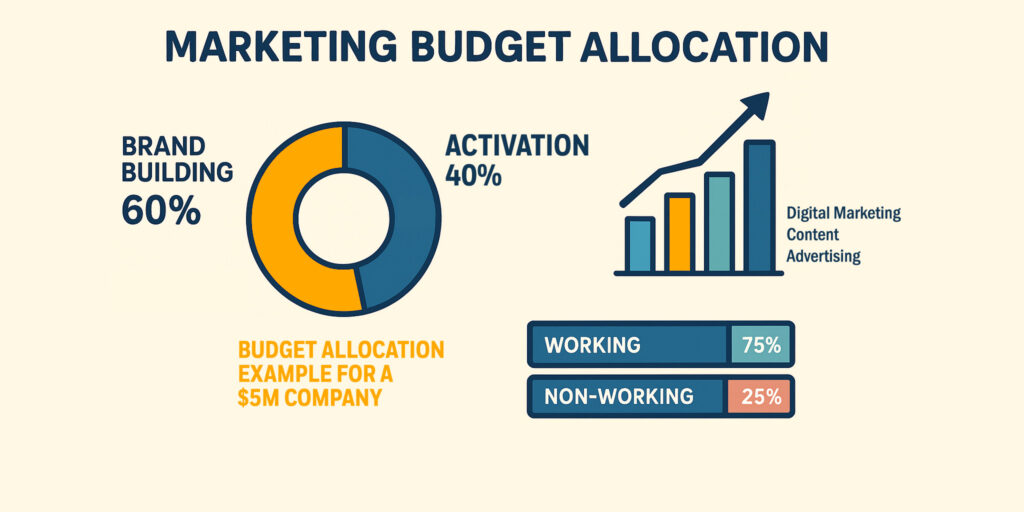
It’s common to separate budget into “brand building” (long-term) and “activation” (short-term, performance). Many benchmark frameworks recommend something like 60/40 brand/activation for many business models.
Protecting brand building is especially important; studies show over focusing on short-term tactics can undermine long-term growth. The work from the UK’s IPA on long vs short marketing provides strong evidence.
Working vs Non-Working
Break your budget into:
- Working spend: the media, paid channels, promotions that put dollars directly into market
- Non-working spend: creative production, research, tools, agency fees
A good target is ~70%–80% working spend, leaving ~20%–30% for non-working costs. If non-working grows too large, you sacrifice reach and impact.
Sample allocation for a $500K budget
For a company choosing ~$500K (10% of revenue) as the marketing budget:
- Brand building (~60%): ~$300K
- Activation (~40%): ~$200K
Within those:
- Working spend (~75% of total): ~$375K
- Non-working (~25%): ~$125K
This gives you actionable buckets and clarity.
Making the Budget Appropriate: Context, Guardrails & Measurement
Tailor to Your Model
- In B2B with long cycles and high ACVs, you may spend a lower % of revenue but higher cost per account.
- In B2C or DTC models with lower ACV but high volume, you may lean toward the higher % and emphasize brand reach and activation.
Set Guardrails & Metrics
- Ensure your CAC payback (or marketing spend to incremental margin) is within acceptable limits for your business.
- Look for diminishing returns: as you scale spend in a channel, the incremental ROI typically falls. Use marketing-mix modelling (MMM) or simpler tests to evaluate. Wikipedia+1
- Set quarterly reallocation cadence: review performance, reassign budget from under-performing channels to higher-return ones. Abacum+1
Align with Business Goals
Start with objectives: Are you trying to increase share, launch a new product, defend against competitors? Your budget must match those goals. For example, a brand-launch may require a higher brand-spend; a mature product may skew more toward activation. The HBS blog emphasizes mgoal-alignment as one of four key factors in marketing budgeting. Harvard Business School Online
Use Industry Benchmarks
Benchmarks help you explain your budget to stakeholders. For instance:
- Some sources cite ~7.7% of revenue as average marketing spend across companies in 2024. Wise+1
- The “70/20/10” rule (70% proven channels, 20% emerging, 10% experimental) can guide how you allocate within marketing. Wise+1
Using benchmarks doesn’t replace your logic, but it gives you credible guardrails and context.
Example for a $5 Million Company
Let’s walk through a plausible plan:
- Revenue: $5 million
- Marketing budget: 10% = $500,000
- Objective: +15% growth, new product launch, defend category share
- Split:
- Brand building: $300K
- Activation: $200K
- Working vs Non-Working:
- Working media: ~$375K
- Non-working (creative/tools/research): ~$125K
- Details:
- Brand building: discover-reach campaigns (video/CTV), creative platform refresh, key influencers, PR/earned media, retail media brand buys.
- Activation: Paid search/Shopping, retargeting, affiliate marketing, CRO experiments, promotions.
- Metrics & governance:
- Target CAC payback < 12 months (or as fits your margin model)
- Quarterly review: channel CPA, conversion rate, ROI incremental lift
- Minimum brand-floor: maintain consistent spend on brand regardless of quarterly shifts so you don’t erode long-term cost of acquisition.
- Adjustment process: if paid search CPA grows beyond blended CAC +20%, pause and reallocate into better-return channels; maintain at least 60% of budget in brand line.
SEO Considerations & Why This Matters for Growth
For your company’s website, blog or resource center, writing about marketing budget allocation helps you capture search traffic with keywords such as: marketing budget allocation, how much to spend on marketing, marketing budget for small business, brand vs activation budget split. These terms are frequently searched by marketers and small business owners.
By using clear headings (H2/H3), incorporating statistics (with links), and providing actionable examples, you improve the likelihood of ranking for these queries. Also linking to authoritative resources (e.g., HBS blog, benchmark reports) improves credibility and signals value to search engines.
Moreover, including your target persona (CMOs of ~$5 M revenue companies) helps you tailor content for a specific audience, increasing relevance, engagement, and ultimately conversions (downloads, consultations, etc.).
The Bottom Line
For a ~$5 million revenue company, an annual marketing budget of ~10% of revenue (i.e., ~$500K) is a strong starting point when growth is a priority. From there:
- Protect a brand-building floor (e.g., ~60%)
- Allocate ~40% to activation
- Keep ~70–80% of the total as working spend
- Align spend with objectives, metrics, and benchmarks
- Review and reallocate budget quarterly
By following this structured, data-driven approach, your marketing budget becomes a strategic growth lever — not just a cost to control. And when you communicate this framework internally (to CFO, Board, stakeholders), you position marketing as a measured investment, grounded in ROI, aligned with company goals, and benchmarked against credible industry norms.
References & Further Reading
- Planful: Mastering Marketing Budget Allocation – Best Practices Planful
- Improvado: How to Create a Marketing Budget – Complete Guide for 2025 Improvado
- Harvard Business School (HBS): 4 Factors When Creating a Digital Marketing Budget Harvard Business School Online
- HubSpot: How Much Should Your Team Spend on Marketing in 2025 HubSpot Blog
- Abacum: Marketing Budget Allocation Strategies for CFOs & CMOs Abacum
- Wise Blog: A Strategic Guide to Marketing Budget Allocation Wise
- Camphouse Blog: Marketing Budget Allocation – Tips for Success & Growth Camphouse
About Brand4Market
Founded in 2010 by Wendy Flanagan, Brand4Market provides digital and traditional creative services to marketing leaders and business owners for B2B and B2C marketing. Client industries include accounting, broadcasting, construction, electronics, finance, insurance, legal, market research, non-profits, retail, and security. Clients enjoy professional, responsive service and deliverables such as branding, CRM consulting, CMS consulting, collateral design, direct mail, e-commerce, email marketing, marketing automation consulting and implementation, marketing planning, print and online advertising, SEO, social media marketing, trade show design, website design and development, and website maintenance. For more information, visit https://brand4market.com.